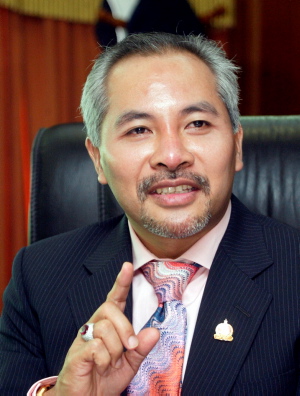
 SHAH ALAM: Selangor opposition leader Dr Mohd Khir Toyo today predicted that the state would became bankrupt in 2013 due to Menteri Besar Khalid Ibrahim’s bad budgeting.
He said he doubted that the RM1.4 billion state budget that Khalid unveiled yesterday would help the state avoid a high deficit.
He recalled that Khalid had to seek supplementary budgets amounting to RM578.4 million last year, making the total 2010 Budget RM1.97 billion instead of the RM1.4 billion originally tabled in the State Legislative Assembly.
“The menteri besar has proudly announced that this year’s budget is a balanced budget, but Selangor has been plagued with budget deficits for two consecutive years,” Khir said during the state assembly debate on the budget.
He said Selangor under his administration recorded a surplus of RM72.51 million in 2006 and increased this to RM131.88 million in 2007.
“But in 2008, when Pakatan Rakyat took over the state government, the surplus was reduced to only RM49.1 million,” he said, adding that the state accounts showed a deficit of RM65.96 million in 2009.
However, he admitted that the 2011 Budget would be “realistic” as long as Khalid refrained from applying for a supplementary budget.
“Last year, it showed a deficit of RM65.98 million. In 2010, it is expected to be RM144 million and maybe more.
“What will happen in 2011? I am troubled that Selangor may be bankrupt by the next general election in 2013 due to imprudence.”
Khalid retorted that Khir had “probably not studied accounts and budgeting".
He said the budget would be reviewed periodically to prevent under-budgeting and over-budgeting.
“So there is no such thing as a budget being exact in expenditure and returns,” he said.
The menteri besar also said Selangor had achieved a surplus of RM268.18 million, the highest recorded in five years.
He suggested that Khir “do some research” on BN-led states to determine if they had balanced budgets.
“If he is worried that the state faces bankruptcy, he should alert the prime minister because he is in charge of bankruptcies,” he said.

Baghdad, Iraq -- All Christians in the Middle East are now "legitimate targets," al Qaeda in Iraq announced Wednesday, as the group's deadline for Egypt's Coptic church to release alleged Muslim female prisoners expired.
An audio message released Monday gave the church 48 hours to disclose the status of Muslim women it said are imprisoned in Coptic churches in Egypt.
The message purportedly came from the Islamic State of Iraq, which claimed responsibility for an attack on a Baghdad church Sunday that killed 58 people and wounded 75. The umbrella group includes a number of Sunni extremist organizations and has ties to al Qaeda in Iraq.
The group said the women's alleged plight was the reason it stormed the church.
Wednesday, the group released a new message saying, "The Ministry of War of Islamic State of Iraq declares that all the centers, organizations and bodies of Christian leaders and followers have become legitimate targets by the Mujahedeens, wherever our hands will reach them."
Shortly after the message was released, Egyptian police sources confirmed that security has been reinforced at churches around the country.
Additional protection was also being provided to the head of the Coptic Church, Pope Shenouda III, who is scheduled to give a sermon in Cairo in the evening, according to a police spokesman who could not be named in line with policy.
Copts are adherents of an Egyptian sect of Christianity. About nine percent of Egyptians are Coptic, according to the Central Intelligence Agency World Factbook; 90 percent of Egyptians are Muslim.
"This is a matter of extreme seriousness and we should not underestimate the threat," said Yusif Sidhom, editor-in-chief of Watani, a weekly Coptic newspaper published in Cairo. "We have to keep our eyes wide open and take all measures to ensure that our buildings and churches are not infiltrated."
Sidhom said he was encouraged by the security measures taken by the Egyptian government, as well as by the position taken by political forces in Egypt, including the Muslim Brotherhood, which has condemned the attack on the church in Baghdad and condemned threats against Egyptian Copts.
Worshippers at the Sayidat al-Nejat church in Baghdad were about to begin Sunday night services when gunmen entered the church, according to Martin Chulov, a journalist for Britain's Guardian newspaper, who was at the scene.
As many as 120 people were taken hostage, said Lt. Col. Eric Bloom, a U.S. military spokesman. The gunmen held them for hours before security forces stormed in to end the standoff, arresting eight suspects.
Most of the hostages were killed or wounded when the attackers set off explosives inside the church, Iraqi Defense Minister Abdul Qader Obeidi said.
At least two of the attackers were wearing explosive vests, which they detonated just minutes before security forces raided the church, police officials said.
The gunmen were demanding that the Iraqi government release a number of detainees and prisoners in Iraqi prisons, saying the Christian hostages would be freed in return, according to the police officials. Iraq's defense minister later said on state television that the kidnappers had demanded the release of a number of prisoners in both Iraq and Egypt. -CNN
The US has announced a $2bn (£1.3bn) package of military and security aid to Pakistan on the final day of the latest Washington-Islamabad strategic talks.
Secretary of State Hillary Clinton unveiled the five-year deal, which is subject to Congressional approval.
But the Obama administration will make clear it expects Islamabad to do more in the fight against Islamic militants.
The US has given Pakistan more than $1bn of military aid a year since 2005; last fiscal year, it gave nearly $2bn.
US officials said Pakistan needed further, specific assistance for the fight against militants and needed to know it could rely on the US in the long term.
Continue reading the main story
Taliban Conflict
Who are the Taliban?
Q&A: Fighting the Taliban
Challenges for Afghan forces
Suspicion over Nato tanker attacks
So unlike previous military aid approved on a yearly basis, this is a five-year package.
The aid will pay for equipment needed in counter-insurgency and counter-terror operations, among other things.
'Reducing threats to US'
Vali Nasr, a senior adviser on Pakistan and Afghanistan at the state department, told the BBC that the battle against Pakistani militants had expanded over the last year, but the summer's monsoon floods had undone a lot of the Pakistani army's efforts.
"We believe that we have made a great deal of progress and we believe that that progress has reduced the threat to our homeland, while not eliminating it," Richard Holbrooke, the US special representative on Afghanistan and Pakistan, said this week.
But officials in Washington have also been frustrated at the limits of Pakistan's desire and ability to help.
A White House report sent to Congress earlier this month lamented the Pakistani army's inability to hold territory it had seized from insurgents, a failure that means gains are likely to be short-lived.
"The Pakistan military continued to avoid military engagements that would put it in direct conflict with Afghan Taliban or al-Qaeda's forces in North Waziristan," the report said, referring to the region in north-western Pakistan seen as a Taliban and al-Qaeda haven.
"This is as much a political choice as it is a reflection of an under-resourced military prioritising its targets."
The report also said the civilian leadership did not have the trust of the people and faced "broad-based" challenges that had "the potential to impact the stability of the government".
US officials said Pakistan needed further, specific assistance for the fight against militants
Cross-border attack
Mr Nasr said the solution was not to withdraw US investment from Pakistan, but rather to help the Pakistani government and military strengthen the country's institutions.
The Pakistani government is in fact crucial to that strategy, and this can make Washington vulnerable.
A crisis in ties between the two countries last month has highlighted the fine line the Obama administration must walk as it cajoles and pressures its ally.
After at least two Pakistani troops were killed in a Nato cross-border attack in September, a furious Islamabad blocked the main transit route for military supplies to Afghanistan until it received a formal apology.
During the row, dozens of lorries laden with fuel and supplies were destroyed by militants in Pakistan while en route to the frontier.
The US-Pakistan strategic dialogue, which started last year, is designed to build trust and keep the conversation going between the two countries, not just about security, but about a wide range of issues from healthcare to education and water projects.
'Not enough sticks'
The five-year package announced on Friday is meant to complement a $7.5bn package of civilian aid over five years that was approved by the US in 2009.
It is all designed to reduce Islamic militants' allure and to win Pakistanis' hearts.
"We want to expand the security relationship that Pakistan and the US had in the past under the Bush period to be much broader," Mr Nasr said, "to involve things that also matter to Pakistanis and impacts their daily lives.
"A relationship means that we don't focus only on things that are important to us, but also things that are important to Pakistanis.
"Average Pakistanis have to see value in their engagement with the US before they subscribe to that relationship."
But some question the Obama administration's approach, saying there are too many carrots and not enough sticks, and not enough conditions attached to the carrots.
TEMERLOH, Oct 21 (Bernama)-- The Temerloh High Court here today ordered former Lipis Umno secretary Zulkifli Othman to pay RM250,000 damages to Padang Tengku assemblyman Abdul Rahman Mohamed for having libelled the latter, two years ago.
Judicial Commissioner Datuk Akhtar Tahir made the decision after finding that based on the evidence presented and testimomy adduced from witnesses, Zulkifli had indeed defamed the assemblyman.
Zulkifli, 54, had done this in a statutory declaration, copies of which were circulated around prior to Lipis Umno''s divisional polls in 2008.
In it, he had claimed that Abdul Rahman, 48, like to flirt around and the judge held that the document was aimed at tarnishing the image of the assemblyman, who was contesting the division chief post.
In the civil suit, Abdul Rahman was represented by counsel Ahmad Nizam Hamid while the defendant by counsel Abdul Majid Md Yusof.
When met by reporters afterwards, Abdul Rahman said he was very happy that his reputation had not been smeared and that he would be donating part of the money to orphanages.
PUTRAJAYA: The Election Commission (EC) has set Nov 4 as polling day for the Batu Sapi parliamentary seat, while nomination is on Oct 26, EC's deputy chairman Wan Ahmad Wan Omar announced here today. The dates are the same as for the Galas state seat by-election in Kelantan.
The Batu Sapi seat fell vacant following the death of its incumbent member of parliament Edmund Chong Ket Wah, 54, in a road accident along Jalan Sembulan-Tanjung Aru, Sabah on Oct 9.
Chong, the Parti Bersatu Sabah (PBS) treasurer, won the Batu Sapi parliamentary seat at the 2008 general election beating independent candidate Chung Kwong Wing by a majority of 3,708 votes. Chong had garnered 9,479 votes.
Chong's death triggered the 13th by-election for the country since the March 2008 general election.
The seat has 25,582 registered voters, including 1,575 postal votes.
The Galas seat fell vacant following the death of its PAS rep Che Hashim Sulaima on Sept 27. BN/Umno is expected to face PAS in a straight fight here.
Batu Sapi, which will see the nation's 13th by-election since the 2008 general election, is expected to pit BN against PKR.

GUA MUSANG, Oct 14- Everyone in Umno and Barisan Nasional (BN) is in high spirits to help wrest back the Galas state seat from the opposition in the by-election on Nov 4, says BN Galas by-election director Tengku Razaleigh Hamzah.
Tengku Razaleigh, who is also Gua Musang member of parliament and the Umno division chief, said all quarters must be united and work together with him throughout the by-election campaign to realise the aim.
"We must do our best if there is a contest. I hope we will carry out our campaign work well with the assistance of everyone concerned.
"I've just arrived here (in Gua Musang) today but I've already heard that the branch leaders and others are all geared up for the by-election. God willing, we will start moving our election machinery with the help of all our supporters," he said before attending the Gua Musang Umno division's special meeting, here Thursday.
Also present were division deputy chief and Nenggiri assemblyman Mohd Yusof Ghani, division Wanita head Datuk Wan Hazani Wan Mohd Noor and its Youth head Bazlan Baharuddin.
Since appointed by-election director, Tengku Razaleigh returned here for the first time, arriving at 4.30pm to prepare BN's machinery for the by-election.
On the special meeting, he said they discussed several matters on the agenda, including the list of proposed candidates for BN in the by-election, but the prime minister (Datuk Seri Najib Tun Razak) would make the final decision.
"Anyone can contest for BN in the by-election provided he is an Umno member and qualified to do so," he said.
On speculations that the Umno division secretary Aziz Shamsuddin and Bazlan were among the possible candidates, Tengku Razaleigh said he did not know about that.
The Election Commission has fixed Oct 26 for nomination of candidates and Nov 4 for polling.
The Galas by-election will be held following the death of its assemblyman Che Hashim Sulaima, 46, from PAS, on Sept 27 due to colon cancer.- BERNAMA

Speculation is rife among Sarawak MPs that the state assembly will be dissolved in November to pave way for state elections in which Barisan Nasional (BN) is expected to retain power while ceding ground to Pakatan Rakyat (PR).
The 2011 Budget announcement tomorrow is also expected to give added emphasis to the East Malaysian state to provide the catalyst for a dissolution of the state assembly early next month.
While BN is in no danger of losing the state government, winning by a two-thirds majority in the 71-seat chamber seems unlikely if the PR coalition of DAP, PKR and PAS perform as predicted.
DAP is expected to win most of the 17 Chinese-majority seats in Sarawak, but not without a hard fight as was seen in the recent Sibu by-election, which has a 76 per cent Chinese majority but was won marginally by DAP.
The Sarawak United People’s Party (SUPP), in trouble with Chinese voters since 2006, is being told that BN will be able to form the next state government without a single contribution from it.
This is the message going out to the party from Sarawak Chief Minister Tan Sri Taib Mahmud, who must call state polls by June next year.
Chinese majority seats were traditionally contested by the Chinese-based SUPP, which, like the MCA and Gerakan in Peninsular Malaysia, has lost the support of the community’s urban voters for its perceived deference to the Bumiputera-based Pesaka Bumiputera Bersatu (PBB).
PBB president Taib will be leading the state BN into battle and is expected to sweep the non-Chinese seats together with the smaller Parti Rakyat Sarawak (PRS) and Sarawak Progressive Democratic Party (SPDP).
Despite pressure from Kuala Lumpur to retire and put a new face in charge to win both urban and rural support, Taib, despite continued allegations of corruption, has convinced the federal government that it risked losing the entire state if he was not in place — a blow they can ill-afford with the country seen to be on the cusp of a general election.
“The thinking is that while Barisan is set to lose the urban Chinese vote, without Taib they might also lose the rural Iban vote and lose the government as well,” a Sarawak Barisan leader said.
“We are set on the lesser of the two evils, lose Chinese votes and still win the government or lose Taib and lose everything.”
“This argument has won the day because all the corruption allegations are only an issue with urban voters in Sarawak and elsewhere in Malaysia. It is not an issue in rural Sarawak where development is the main and only issue,” he added.
Another BN leader believed Taib could still deliver a needed victory for the coalition, “Here Taib is still strong and can pull the votes for one final time.”
However, BN’s ability to dominate the state assembly will be in doubt if the PKR and PAS also do as well as the DAP is expected to.
But observers say PKR in Sarawak was in disarray and heavily splintered along ethnic and religious lines, even with Baru Bian — a lawyer, anti-corruption champion and defender of native land rights — leading.
It was further alleged that “operatives” have infiltrated the state PKR and were likely to spark splinter groups, further weakening the party.
Such breakaways are a phenomenon in Sarawak politics that has traditionally been employed to weaken the opposition while burnishing the image of the ruling coalition.
PAS, on the other hand, has yet to make inroads into Sarawak politics because Islam is not a political force in the state as it was in Kelantan or Terengganu.
This is the case even in Muslim majority areas, and if PAS is to win, it will need help from DAP and, to a lesser extent, PKR.
“It might win one seat,” said a DAP leader, “if we agree to give up a marginal Chinese seat to them.”
DAP’s weakness is that although it is a nominally a multi-racial party, it prefers to contest only in Chinese majority areas where it has formed branches and established a network.
“We left organisational work in Malay/Muslim/Iban areas in the interior to PKR,” said the DAP leader. “Problem is they (PKR) are weak and fractured and have not organised anything.”
“So you can guess the results (election outcome),” he said.

The Kelantan royal palace has revoked the datukship of Independent Pasir Mas MP and Perkasa president Ibrahim Ali.
The palace has also revoked the title carrying the term "datuk" of former state secretary Wan Hashim Wan Daud.
When contacted, Ibrahim confirmed that he was informed of the matter earlier this morning by the Kelantan secretary of the revocation.
The title was bestowed on him by the then Kelantan sultan, Sultan Ismail Petra.
“I do not know the reasons, but on Oct 7, I had visited Sultan Ismail at Istana Mahkota. Since his illness and return to Kelantan, this was the first time I visited him. I am very close to Sultan Ismail.
“Whatever it is, it is not an issue to me. I accept it (the news) with an open heart,” said the veteran politician in an SMS message.
According to the Perkasa chief, he has been completely loyal to the current Kelantan Sultan, Tuanku Muhammad V.
“I maintain my stand, which is to uphold the institution of the rulers, because it forms the basis of the country's constitution and is a part of the Malay culture to extol the sovereignty of the ruler. Ampun Tuanku,” he said.
Ibrahim also clarified that he was still 'datuk' as he was awarded datukships in Selangor and Melaka. - Malaysiakini
KUALA LUMPUR, Oct 12 – Despite growing criticisms for not acting against several racist civil servants, the government insisted today that it would not enact a Race Relations Act.
In a written reply to Karpal Singh (DAP-Bukit Gelugor) in Parliament today, Minister in the Prime Minister’s Department in charge of unity affairs Senator Tan Sri Dr Koh Tsu Koon explained that this was because the country had enough laws to govern race relation issues.
He also pointed out that the Chief Secretary to the Government Tan Sri Mohd Sidek Hassan had already issued a general service circular to all heads of government departments on October 1, reminding their officers to refrain from making statements touching on racial and religious sensitivities.
“The suggestion to enact the Race Relations Act rose following several sensitive issues and racial statements that have been hotly debated by many individuals and given wide coverage in the print and electronic media since the middle of 2008.
“The objective of this Act was to prevent and take action against individuals or groups whose remarks or behaviour destroys the relationship between the races,” he said.
Koh noted that the National Integration and Unity Department was tasked by the Cabinet to study and make comparisons between similar laws in different countries as well as to hold roundtable discussions with the Institute of Ethnic Studies, Universiti Kebangsaan Malaysia, academicians, NGOs and both the private and public sectors.
“Based on the summary of the department’s report, the Cabinet, in January 2009 already decided that there was no need to enact a Race Relations Act because the existing laws of the country were sufficient to handle these issues.
“If need be, the current laws can be revised, examined, clarified and amended, as well as carried out more effectively and fairly,” he said.
Koh claimed that in making this decision, the Cabinet had also taken into consideration that the Federal Constitution was the country’s official platform that clearly took into consideration the interests of all the races in the country while the Rukunegara was its guiding principles.
“Additionally, it was found that laws alone cannot force a person to like another. Hence, it is more important to prioritise the application of moral values and a change of attitudes through education and socialisation as it might bring about more effective and sustainable results,” he said.
Koh also underscored several programmes introduced by Prime Minister Datuk Seri Najib Razak since he took office like 1 Malaysia, the Government Transformation Programme and the Economic Transformation Programme, which he claimed further helped to strengthen unity in diversity.
“However, as a result of recent incidents of civil servants uttering statements that touched on racial sensitivities, the Chief Secretary to the Government issued the circular on October 1 to state the government’s stand on preventing statements and actions that could destroy the relationship between the races.
“The circular also explained on principles and disciplinary actions that would be taken to deal with such cases. Any further suggestions on how to improve these actions can be considered,” he said.
The government has come under fire in recent days for failing to act quickly on several civil servants including an official from the government’s National Civics Bureau and two school principals for allegedly uttering racial slurs.
The BTN official Hamim Husin had, during a recent closed-door Puteri Umno function, referred to the Chinese and Indian communities as “Si Mata Sepet” and “Si Botol” respectively when asking Puteri Umno members to approach the non-Malays for votes.
“The ‘si mata sepet’ that has never gone to a mosque or surau only has one vote. The ‘si botol’ that only knows how to go up to Batu Caves up and down only has one vote,” Hamim told the closed-door gathering, as reported in The Malaysian Insider.
Siti Inshah Mansor, the principal of SMK Tunku Abdul Rahman Putra, had allegedly told students during an assembly that the Chinese could return the China and likened Hindus to “dogs” because of their prayer strings.
“Pelajar-pelajar Cina tidak diperlukan dan boleh balik ke China ataupun Sekolah Foon Yew. Bagi pelajar India, tali sembahyang yang diikat di pergelangan tangan dan leher pelajar nampak seakan anjing dan hanya anjing akan mengikat seperti itu,” she had allegedly said.
Another principal in Kedah had allegedly told off several Chinese students and accused them of disrespecting the Muslims by eating in the school canteen during fasting month.
When speaking on the issues today, Mohd Sidek said that the government would follow proper procedures in dealing with the two racist principals and a National Civics Bureau official for allegedly making racial remarks. He however did not say whether the three had been found guilty or whether they had already been disciplined.
“There are rules and regulations in which we have to follow and I will make sure that they are followed,” Mohd Sidek told reporters after attending a seminar at the Institute of Islamic Understanding Malaysia (IKIM).
Yesterday Speaker Tan Sri Pandikar Amin refused to allow a debate in Parliament over the alleged racial slurs made by two school headmistresses, claiming that action had already been taken against them.
Pandikar did not, however, provide any details on the supposed action taken against the two.
Asked today about the case involving the BTN assistant director Hamim Husin, Mohd Sidek replied: “The same [as for the two principals].”
He declined to comment further.

Channel News Asia has made a report that a popular brand of instant noodle Indo Mie has been banned in Taiwan due to the discovery of hydroxy benzoic acid been used as a preservative in the termed noodle. Below the report taken directly from CNA website. Seems our government need to carry out the similar action for our country.
SINGAPORE : Singapore's Agri Food and Veterinary Authority (AVA) said it is carrying out investigations to ensure that Indomie noodles available in Singapore are safe for consumption.
This follows reports that Taiwan has banned Indomie's Mi Goreng.
Taiwanese authorities said para hydroxy benzoic acid, a preservative meant for cosmetics, was found in the instant noodles.
Singapore's AVA said para hydroxy benzoic acid is not allowed here in instant noodles.
Tests have been carried out, but AVA is not initiating any recall at the moment.
It said results should be completed soon.
Indomie instant noodles are produced by Indonesia's publicly-listed food giant PT Indofood Sukses Makmur. -Channel News Asia

KUALA LANGAT, Oct 10 — Pertubuhan Pribumi Perkasa Malaysia (Perkasa) has lamented that the non-governmental organisation (NGO) continues to be treated as a punching bag by certain quarters just because it is defending Malay rights.
Its president Datuk Ibrahim Ali said Perkasa was not a racist or extremist group as labelled by some quarters as it also rejected racism.
“As far as we are concerned, we are only defending Article 143 of the Federal Constitution, besides speaking up on economic issues as this is part of the democratic process,” he told reporters after launching the Kuala Langat chapter of Perkasa, here, today. Also present was Kuala Langat Perkasa chairman Datuk Abdul Fatah Iskandar.
Ibrahim was earlier asked to comment on the call by MCA Youth for the Barisan Nasional leadership to separate itself from extremists or extremist groups in the country.
The movement’s head Datuk Wee Ka Siong said this move was important in BN’s effort to lobby for the people’s support and in fulfilling its responsibility of looking after the interests of all communities, so that no group would be marginalised in the development process.
On Wee’s statement that MCA Youth respected the social contract and Federal Constitution, Ibrahim asked Wee to give his own definition and explain his understanding of the matter.
Ibrahim who is also Pasir Mas member of parliament, also questioned Wee’s stance of only criticising Perkasa’s struggle but did not do the same over Hindraf’s London-based chairman P. Waythamoorthy questioning the words of caution from the Sultan of Johor, Sultan Ibrahim Almarhum Sultan Iskandar, on Oct 4 over the issue of raising sensitive issues.
“He (Wee) also did not pressure the government to set up a royal commission of enquiry into claims that DAP leaders had benefited in terms of timber concessions when the opposition pact governed Perak.
“We were also called primitive which we don’t mind, as it can also mean ‘original’ and also because we are only defending Malay rights,” the Perkasa leader said.
Asked whether Perkasa had any plans to field a candidate in the next general due to increasing support for the NGO, Ibrahim said they did not think about it as Perkasa was not a political party and its focus was on uniting the Malays. — Bernama

KUALA LUMPUR, Oct 7: PAS's non-Muslim wing, the PAS Supporters Congress (DHPP), said Najib Razak and UMNO were ill-equipped to counter Islamophobia as they subscribed to racialism and had the tendency to fan racist sentiments.
“UMNO or Najib Razak cannot solve the problem of Islamophobia because they like to fan racist sentiments," said DHPP's deputy head N. Bala Subramaniam (pic).
He was responding to Najib's statement during the Asean-US meeting in New York, in which Najib offered Malaysia's assistance to president Barrack Obama in combating a recent spate of Islamophobia across the United States, including the call to burn copies of the Qur'an by a pastor.
"The most important step is to provide the basic knowledge about Islam; that Islam carries universal values, a progressive religion which is very much in line with the concept of modernisation," Najib was reported as saying.
Bala said PAS had the advantage over UMNO due to the calibre of its leaders such as Tuan Guru Nik Abdul Aziz Nik Mat and the party's National Unity chairman Mujahid Yusof Rawa, who he said had opened the eyes of non-Muslims towards Islam and the basis of PAS' struggle.
"Nik Aziz, Dr Mujahid as well as other leaders are more qualified and capable (in tackling Islamophobia),” he told Harakahdaily today, adding that PAS's two-decades of administration in Kelantan proved its commitment to harmony between religions and races.
“Over 20 years of governing (Kelantan), we have not heard Tok Guru [Nik Aziz] speaking ill of any other religions.
"Tok Guru likes every community who has faith in God so that they can improve,” he added.
On Mujahid, who is PAS's Parit Buntar member of parliament and who has been instrumental in the establishment of DHPP earlier this year, Bala said he had helped a lot to bring about friendly relations between PAS and non-Muslims.
This, Bala added, was in stark contrast to the practice by UMNO to keep non-Muslims at bay and not approach Islam.
“In Najib’s era, non-Muslims not only cannot enter mosques, Allah’s name too cannot be uttered,” he said.
On the upcoming by-election in Galas, Kelantan, Bala said DHPP was currently helping to mobilise volunteers from the non-Muslim community to help PAS defend the seat.
“I am confident that Orang Asal in Galas will complete our machinery,” said Bala, referring to the constituency's seizable Orang Asli voters.

KUALA LUMPUR: The Chinese should not be seen as kaum pendatang (migrant folk) and have been loyal citizens of Malaysia for the past three to five generations, said Prime Minister Datuk Seri Najib Tun Razak.
“We should not look behind with sentiments of the past. We must look forward because we are building a Malaysian nation that is progressive and successful on the global stage,” he said when opening the 57th MCA general assembly on Sunday.
Najib urged the public to focus on how the Chinese and Indian communities could work with the Malay and other communities to create a fair society despite differences in interpreting what constituted a fair society.
“There can be a big polemic on what is a fair society. A Malay leader’s definition of fair can be different than your definition of fair but eventually we must converge,” he said.
Najib said there was a need to develop the economy equitably to have a fair distribution of wealth depending on the size of the community.
“It is a conventional wisdom and rational thinking that if the majority of a country has a very small percentage of the wealth, that is not equitable. I think MCA would also agree.
“So, we need to have a nice balance that the Malay feels they have a bigger share in economic wealth but the Chinese also feel they are growing economically in our system,” he said.
He added that was the reason to aim for a 6% economic growth in the next 10 years to ensure the economic pie grew.
“When you expand the pie, in absolute terms, we are getting better. We must look for a fine balance. Malays also have their aspirations and their fears, the other communities have their wishes. In all these things, let us look at it from the Malaysian context,” he urged.
He also urged the country to find ways to work together to bring to fruition policies contained in 1Malaysia, Government Transformation Programme, Economic Transformation Programme and 10th Malaysia Plan.
“We must be realistic, not emotional. Not racist but realistic. Embrace the need to work together like how our forefathers have shown the way,” he said.
Najib also reminded that the 1Malaysia concept was a work in progress to create an equitable and fair society.
“When I announced 1Malaysia, it cannot be that at the stroke of a pen, everything is perfect, it is a work in progress, a journey, leading us to something better,” he added.
He said even after 22 years in as Prime Minister, Tun Dr Mahathir Mohamad admitted his failure in trying to change the mindset of Malaysians.
Najib stressed that the Government did not condone racist remarks made by its officers but due investigative process must be taken before action could be taken.
“One officer made a racist remark, we take action. We don’t condone racism, I assure you. But proper investigation must be done with due process. But the issue has been amplified because of information communication technology,” he said.
He said that racist remarks should be taken in its cultural context to be sure it did not carry a derogatory connotation.
He gave the example of him being able call his Northern Malay friend with dark skin Non Tok Yu (dark soy sauce) without it being taken as an insult.
“If they made remarks, you must understand the cultural setting. Of course, if applied in the context of Malaysian Indian, it’s derogatory. I don’t use that to describe my friends in MIC,” he said.

Kuala Lumpur, Oct 9 - Tok Batin Mohamad Udin Pakpek of Kampung Permatang Keledang in Pekan, Pahang has questioned Prime Minister Datuk Seri Najib Tun Razak's inaction against FELDA and FELCRA's constant encroachment into Orang Asli ancestral land in Pekan.
"It is his hometown. He is the Prime Minister now. He is also the Member of Parliament (MP) for Pekan. Why didn't he protect us?" Mohamad Udin said during the Impact of Orang Asli Land Policies public forum, conducted by Bar Council of Malaysia earlier this evening.
The Bar Council had organized a public forum regarding the impact of the proposed amendments to the current Aboriginal Peoples Act 1954 by Jabatan Hal-Ehwal Orang Asli (JHEOA) which gives the federal government absolute rights in land ownership and land usage.
"They (FELDA and FELCRA) quietly shifted the border of our land several times, claiming that the land belonged to the Malay reserve.
"I was an ex-officer at JHEOA before they sacked me in 1983 for protecting the rights of Orang Asli. They are supposed to help the Orang Asli but all they have done is destroy the Orang Asli's livelihood. When I opposed them, they sacked me.
"Ever since I joined the Network of Orang Asli Villages (NOAV) and worked closely with Tijah, I have received several warnings from certain parties to stop doing that. They even threatened me that I have one foot in the grave, but I will continue to fight for our rights," said a defiant Mohamad Udin.
Mohamad Udin is one of some twenty Tok Batins (village heads) present today at the forum with about 192 Orang Asli from 7 different states - Selangor, Perak, Pahang, Negeri Sembilan, Melaka, Kelantan and Johor who also turned up to make their voices heard.
Tok Batin Perat Dolah from Kampung Banting, Kuala Langat, Selangor also slammed JHEOA for disregarding the prime minister's directive and their own mandate to protect the Orang Asli.
"PM asked them to protect us but they have oppressed us instead. They are not even here. What are their priorities," said Perat adding that JHEOA had totally snubbed the public forum.
Klik4Malaysia (K4M) had earlier reported that an Orang Asli by the name of Panjang Tangkak had been arrested four times by the authorities for allegedly selling state-owned palm-oil produce.
Panjang, who is from Kampung Mikang, located in Rompin, Pahang, told K4M that the government suddenly came and took away all 12 acres of his land without informing him or giving him any form of compensation.
Sokyen from NOAV who hails from Gombak also chided certain Tok Batin who feared the JHEOA and authorities while urging the Orang Asli in Selangor to unite.
"You have fought tigers and elephants to protect your people and your land. Why are you afraid of them (JHEOA)? The tigers can swallow you whole and yet you fight it but why do you cower in front of the authorities?" he asked.
Sokyen also formally requested assistance from the Selangor government to allocate 10 acres of land for the Orang Asli to use as the Peninsular's central meeting point.
"Selangor is situated somewhere in the middle so I think that this is the best place for all the 18 tribes to gather for meetings and discussions or even hold an event," he explained.
Selangor state representative Elizabeth Wong (pic left), who is also the state's Tourism, Consumer Affairs and Environment Committee Chairperson said that she would definitely take up the Orang Asli request in the upcoming EXCO meeting.
She then told the Orang Asli that the Selangor state government would do whatever possible to protect over 15,000 Orang Asli who are currently residing in the state.
"After two and a half years in power, we have yet to give away any land belonging to the Orang Asli to private corporations and developers. The existing cases that we are working on are due to the former government's (Barisan Nasional) actions," said Wong.
Wong then explained that due to the former state government's aggressiveness in giving out land to private corporations and developers, up to 70% of the land in Selangor was now owned by the private sector.
She reiterated that the Pakatan Rakyat-led state government's stand was protecting the seventy Orang Asli villages in the state, together with their customary land.
Wong also asked the Orang Asli to be patient as the state government was facing various hurdles as both JHEOA and also the National Land Council have refused to assist the state government in gazetting the Orang Asli customary land.
"We are now drawing our own map with a handheld GPS and have almost completed mapping out the Sepang area. We have also set a target to complete gazetting 30% of the customary land in Selangor by end of the year," she added.
Dr Colin Nicholas (pic right), a Coordinator from the Centre for Orang Asli Concerns (COAC) urged the Orang Asli to be more aware of their predicament.
"They are taking away all your lands and then giving you back a small piece of it. On top of that, they want to control what you do with that small piece of land that was 'given' to you. It doesn't have to be this way. Look at the Adong Kuwau case and the Sagong Tasi case.
The government had to pay compensation. You have your rights. This is why they want to amend the Act, to take away all your rights," Dr Colin explained.
He then reminded Orang Asli that although they can challenge the federal government in court, or lobby and protest the proposed amendments or even draft a new law that will protect their rights, the best option for the Orang Asli was to protect themselves by changing the federal government.
Meanwhile, Bar Council Committee Member on Orang Asli Rights, Augustine Anthony, condemned the original Act, calling it unconstitutional while labeling the proposed amendments an even greater violation of the Orang Asli rights.
"There are 19 sections in the Act. If they are amending all of it, they might as well throw it into the dustbin," he said while questioning the logic behind the full revamp.
He then highlighted several clauses where the Rural and Regional Development Minister holds absolute power in determining the identity of an Orang Asli and also the appointment of the Tok Batin.
"Since when do we need a Minister to tell us who we are? The Orang Asli knows who they are so why should they need a Minister to prove their identity?
"And since when do Ministers appoint village heads? Why can't the Orang Asli choose their own leaders?" said Augustine.
"It would seem like democracy applies to all except for the Orang Asli. The Bar Council wants the federal government to repeal the Act and pass a new legislation that will really protect the interests of the Orang Asli," he said in conclusion.
Augustine was one of the four panel members involved in the forum, representing the Bar Council while he was joined by Wong who represented the Selangor state government and also Dr Colin who represented COAC.
Although the Bar Council had invited the minister of Rural and Regional Development Datuk Seri Mohamad Shafie Apdal to represent the federal government, he was unable to attend.

Gua Musang MP Tengku Razaleigh Hamzah today confirmed that he will accept Umno's offer to him to be Barisan Nasional's election director for the Galas by-election, due to be held on Nov 4.
However, he said the decision whether to be a candidate himself will only be made after a meeting with party president and Prime Minister Najib Tun Razak next Monday.
Razaleigh, who returned to Malaysia after a long trip to the United Kingdom this morning, also had a short meeting with Kelantan Umno liaison chief Mustapa Mohamed and Umno information chief Ahmad Maslan at the Kuala Lumpur International Airport (KLIA).
Later at a press conference, Razaleigh said he felt "responsible" to spearhead the election campaign because "I am an Umno member" who has been on the ground since he first joined politics.
"I am also the Gua Musang division head, a Gua Musang MP and I used to be a state assemblyman in Galas, which was previously known as Hulu Kelantan," he said.
The 73-year-old politician also dismissed claims that he was put in a difficult position by Umno when he was offered the role of an election director as well as a candidate amid his well-publicised stand on the oil royalty issue in Kelantan, which echoes the views of PAS ruling the state.
"That (oil royalty) issue does not arise because it is a national issue and cannot be questioned because the matter is in court. It would be sub judice for us to talk about it (during the campaign)," he said.
When asked if he felt “bad” taking up the position, Razaleigh said: "Why should I feel bad? I am an Umno member and I will fight for the people in Galas."
Razaleigh, who was flanked by Mustapa and Ahmad, also discounted allegations that both he and Mustapa are not on the same page since the latter was picked by the party to become the state liaison chief.
'No problem'
Asked whether he could cooperate with Mustapa in the by-election, Razaleigh smiled: "I have no problem working with Tok Pa (as Mustapa is fondly known)... I have no problem working with anybody since the time of the first prime minister Tunku Abdul Rahman...”
Razaleigh, or popularly known as Ku Li, is Umno's favourite candidate after his own Gua Musang division declared its support for him to contest for the seat that fell vacant following the death of incumbent, PAS' Che Hashim Sulaiman.
Other Umno leaders agreed that Razaleigh, who has been Gua Musang MP since 1969, is the right candidate to boost Barisan Nasional's (BN) chances of wresting the seat back from PAS which captured it by a thin 646-vote majority in 2008.
Just after the seat became vacant about two weeks ago, deputy Umno president and Deputy Prime Minister Muhyiddin Yassin, who traditionally heads the BN election machinery in by-elections, agreed that Razaleigh was the perfect choice to lead the BN charge in Galas.
Muhyiddin also did not think that PAS would stand to gain, given Razaleigh's stand on the oil royalty issue. (Razaleigh had stated that Petronas should give oil royalty to Kelantan, a move rejected by the federal government.)
Razaleigh, whose flight landed at the KLIA early today, was greeted by about 50 of his supporters who shouted "Hidup Ku Li" as he walked into the waiting room. Various leaders from the BN, including Gerakan Wanita chief, Tan Lian Hoe, were also present.
Syed Azidi, who used to be a pro-Kelantan PAS blogger with pseudonym “Kickdafella” before a fallout with the state government, was also spotted in the BN crowd.